
Hit On Your Bike By A Driver In Las Vegas?
You had every right to the road, and a driver took it from you in a second. Erik Severino has spent 20+ years taking on insurers and big corporations, and he makes them pay for the medical bills, the lost paychecks, and the pain they would rather pin on the rider. No fee unless we win.
- No fee unless we win your case
- Free, confidential review, available 24/7
- Rated 4.9 across 400+ Google reviews
- A local firm on St. Rose Parkway in Henderson
Get Your Free Case Review
Takes about a minute. We respond fast.
We've Got Your Details
Someone from our team will call you shortly. For immediate help call (702) 360-5000.
What You Capture First Decides How This Ends
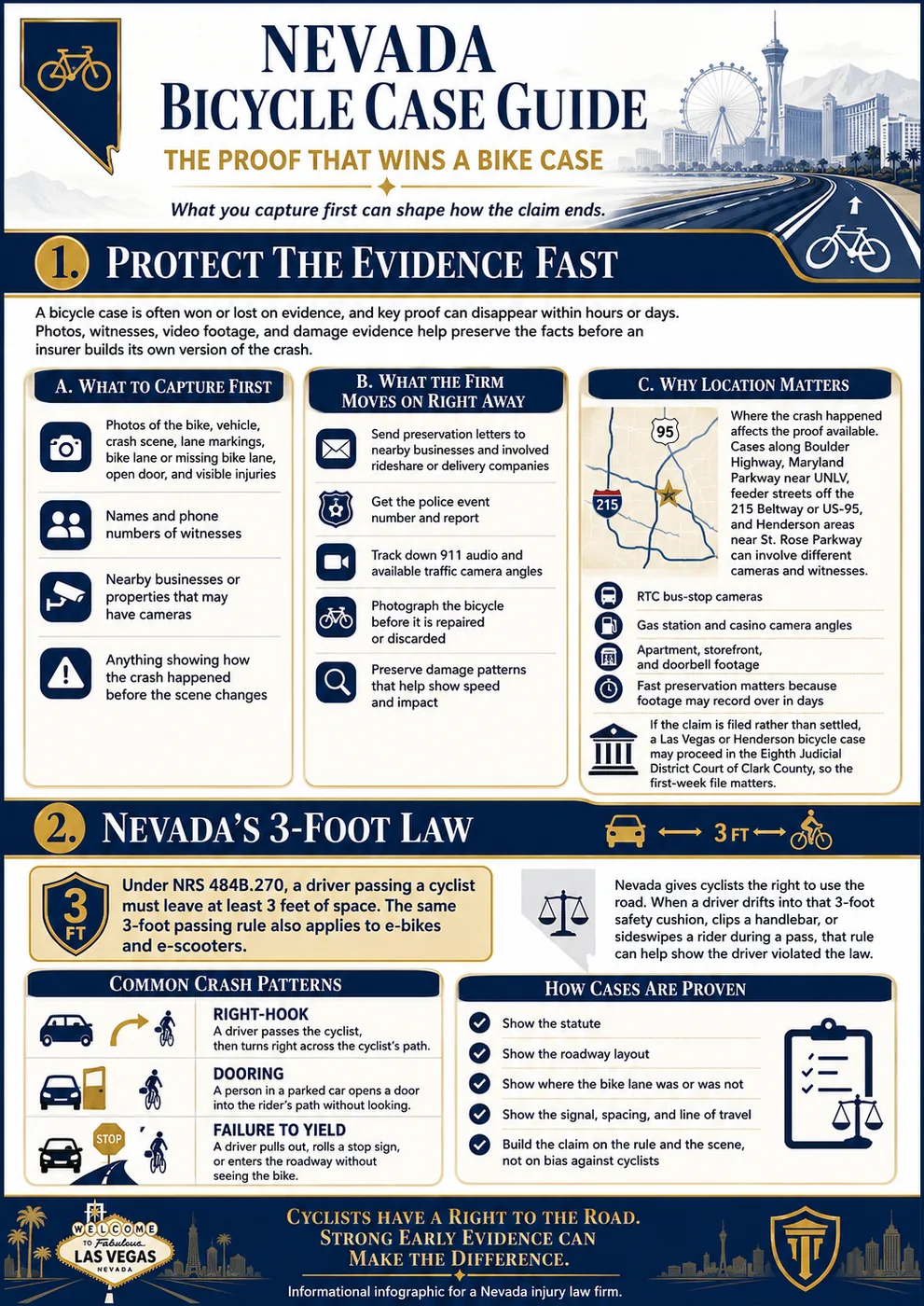
A bicycle case is won or lost on evidence, and most of it starts disappearing the moment the crash is over. A driver who buzzed you on Boulder Highway or cut across you near the 215 Beltway will tell their insurer a tidy story, and if there is nothing to contradict it, that story becomes the file. Your job in the first hours is to make sure the facts survive long enough for someone to use them.
If you can, photograph everything: the resting spot of your bike and the car, the damage to both, the lane markings or the missing bike lane, the door that opened, and your own injuries. Get the names and numbers of anyone who saw it. Note the businesses on the corner, because a gas station, an apartment gate, or a storefront camera may have caught the whole thing, and that footage often records over itself within days.
Here is what we move on right away. We send preservation letters to nearby businesses and to any rideshare or delivery company whose driver was involved. We pull the police event number and the report. We track down the 911 audio and any traffic camera angles. We photograph your bike before it gets repaired or scrapped, because the bend in your frame tells a story about speed and impact that words cannot. The sooner we start, the more of that proof we actually get to keep.
Where you were riding shapes the proof we go after. A crash on the Boulder Highway corridor, along Maryland Parkway near UNLV, or on a feeder street off the 215 Beltway or US-95 puts different cameras in play than a quiet Henderson neighborhood off St. Rose Parkway. We map the RTC bus-stop cameras, the casino and gas-station angles, and the doorbell footage on the block, then send the letters before any of it records over. If the claim ends up filed rather than settled, a Las Vegas or Henderson bicycle case goes to the Eighth Judicial District Court of Clark County, and the file we build in the first week is the one that holds up there.
You Had A Right To The Road, And The Law Backs It
Nevada gives a person on a bicycle the right to use the road, and it puts a hard number on how close a car may come. Under NRS 484B.270, a driver passing a cyclist must leave at least three feet of space, and the same three-foot rule covers e-bikes and e-scooters. When a car drifts into that cushion, clips a handlebar, or sideswipes a rider mid-pass, that statute is often the cleanest way to show the driver broke a rule, not the cyclist.
Three patterns drive most of the cases we see. A right-hook, where a driver passes you and then turns right across your line, cutting you off as you go straight. Dooring, where someone in a parked car flings a door into your path without looking. And a plain failure to yield, where a driver pulls out of a driveway or rolls a stop sign and never sees the bike. Each one usually means the driver, not you, broke the rule that caused the crash.
The bias underneath all of it is the quiet assumption that cyclists do not belong on the road. Adjusters use it. So do some drivers and even some witnesses. The fix is not to argue the feeling, it is to show the rule and the layout: where the bike lane was or was not, what the signal said, how much room the driver actually left. We build the file on the statute and the scene, not on whose side the road is supposed to belong to.

A Bike Offers No Steel, So The Body Takes The Hit
There is no frame, no airbag, and no crumple zone between a rider and two tons of car. Even a low-speed strike can throw you into the pavement or over the hood. These are the injuries that most often bring riders to us.
- ✓Traumatic brain injury and concussion
- ✓Broken collarbone and wrist
- ✓Road rash and deep abrasions
- ✓Fractured pelvis and hip
- ✓Spinal and back damage
- ✓Torn shoulder and knee ligaments
- ✓Facial and dental injuries
- ✓Internal organ trauma
"Eric and his staff were very helpful, knowledgeable and friendly. Made the whole process painless."
The Lines They Use To Blame The Rider
The adjuster on a bicycle claim runs a familiar script, and almost every line is built to push fault onto you. They will say you should have been in a bike lane, even when there was none. They will say you ran the light, wore dark clothing, or came out of nowhere. They will call the impact minor and float a quick check before you know whether your shoulder needs surgery. None of that is an accident. Under NRS 41.141 you can still recover as long as you are not more than 50 percent at fault, so every point of blame they pin on you cuts what they have to pay.
The recorded statement is where a lot of riders lose ground. The adjuster sounds kind, asks you to walk through the crash, and then mines your words for any hint that you were partly at fault. You are not required to give one. It is fine to say you are getting medical care and your attorney will follow up, then hand it to us. We answer each of those lines with a record: the three-foot rule, the witness who saw the car cut across you, the camera that caught the door, the doctor's note that dates your injuries to the day of the crash.
If a delivery or rideshare driver hit you, there may be a second policy in play, and that company's insurer will work just as hard to keep you away from it. Our job is to find every layer of coverage and keep the story straight, so the only version that survives is the one backed by proof.
Where The Money Comes From
Nevada is a fault state, so the driver who caused the crash, really their insurer, pays for the harm. A full claim is far more than the ER bill.
Medical Care
The ER trip, surgery, imaging, physical therapy, and the future treatment a doctor says you will still need.
Lost Income
Wages you missed while healing, plus reduced earning power if you cannot return to the same work.
Pain and Suffering
The physical pain, the fear of riding again, and the things you can no longer do the way you used to.
Your Bike and Gear
Repair or replacement of your bicycle, helmet, and the gear that was destroyed in the crash.
When Your Car Insurance Covers You On A Bike
A lot of riders assume that because they were not in their car, their auto policy is useless. It often is not. In Nevada your insurer must offer you uninsured and underinsured motorist coverage, and that coverage follows you, the person, not just the vehicle. If a driver hit you and fled, or carried the bare minimum and your injuries blew past it, that coverage can step in even though you were on two wheels.
This matters a great deal in a city with so many hit-and-run drivers and so many drivers carrying low limits. After a hit-and-run on a bicycle, your own UM coverage may be the main source of recovery, and your insurer becomes the party you negotiate against. They are supposed to be on your side, but they still protect their bottom line. Bring your declarations page to the first call so we can read your limits and tell you exactly what you have to work with.
You Work With The Attorney, Not A Call Center
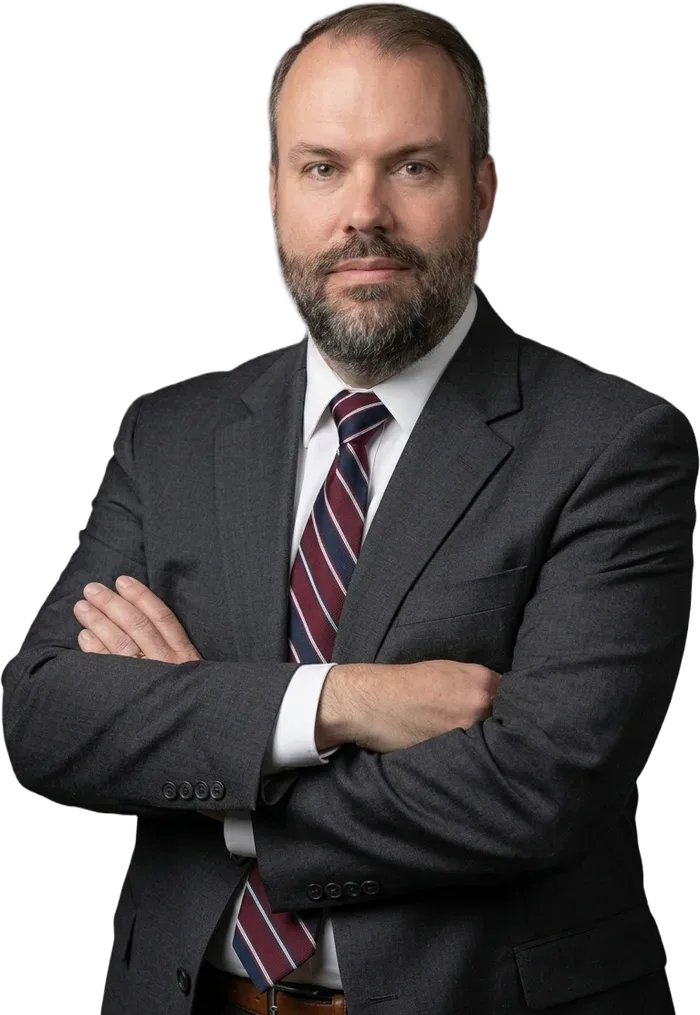
Plenty of firms hand you off to a rotating cast of case managers, and you never speak to the lawyer whose name is on the sign. That is not how this works. Erik has been a licensed Nevada attorney since 2006, and he handles your case himself, from the first call to the final check.
No Fee Unless We Win
You pay nothing up front. Our fee comes out of the recovery, and we go over case costs with you before anything starts.
Available 24/7
Crashes do not keep office hours. Call nights, weekends, and holidays. Hablamos Español.
Local To Henderson And Las Vegas
We know the roads and freeway corridors, the courts, and how the regional insurers operate. You can sit across a desk from your lawyer.
"Erik and his team are top notch. They're expertise, dependability and customer service are all above and beyond! You don't want to need their services, but in these days of COVID, many of us do or will. Look no further!"
Steps That Keep Your Bike Case Strong
You do not have to do all of this perfectly. Do what you can, and we will handle the rest.
Get Checked Out
See a doctor the same day if you can. It protects your health and dates your injuries.
Call The Police
Get the event number on scene. The report pins down who was where and how close the car passed.
Save The Scene
Photos of both vehicles, the road, any missing bike lane, and witness names before they leave.
Keep Your Bike
Do not repair or toss it yet. The damage to the frame is evidence of speed and impact.
Call Erik
We start chasing camera footage and preservation letters from day one, before it is gone.
Under NRS 11.190, you generally have two years from the crash to file a bicycle injury lawsuit. If a city, county, or RTC vehicle was involved, you also have to formally present a claim to that government body before you sue. Talk to us early so a deadline never decides your case for you.
Other Cases We Handle
If your situation does not quite fit a bicycle crash, here are the closest matches and the broader cases we take.
Bicycle Accident Questions, Answered Plainly
Start Your Free Case Review Today
Tell us what happened. We will tell you, honestly, whether you have a case and what it would take to handle it. No pressure, no cost, no obligation.
Prefer to call right now?
(702) 360-5000Start Your Free Case Review
We respond within the hour.