

Medical Care
Treatment for the injury, from the first clinic visit through surgery and therapy, paid without a copay when the claim is accepted.
Covers the doctor, the hospital, the meds, and mileage to appointments.
Nevada workers' comp is supposed to be automatic. In practice, the insurer can delay your checks, lowball your rating, or deny you outright. Erik Severino has spent 20+ years taking on insurers and big corporations, and he makes sure injured workers get the benefits they're actually owed.
Takes about a minute. We respond fast.
Someone from our team will call you shortly. For immediate help call (702) 360-5000.
A workers' comp case is won or lost on documents, not on how much it hurts. The insurer was not at the loading dock or the job site when you got hurt. All they ever see is paper, so the paper has to tell the truth clearly and early. The day you report the injury is the day your case starts taking shape, and the small things you keep now are the things that protect you six months from now.
When you report a work injury in Nevada, the treating clinic fills out a claim form called the C-4. That form, plus your written report to your employer, is the spine of everything. If those dates are clean and close to the injury, the insurer has far less room to argue you got hurt somewhere else or waited too long. If they are messy or missing, expect a fight. Here is what we ask clients to hold onto from day one.
You do not have to gather all of this perfectly. Bring us what you have, even if it is a shoebox of clinic papers and a few phone photos, and we will build the file from there. The goal is simple: by the time the adjuster makes a decision, the record already answers the questions they were planning to use against you. If your claim has already been denied, the records you saved become the heart of the appeal.
Nevada workers' comp is a no fault system built into NRS Chapter 616, and that one design choice explains almost everything that happens to your claim. You don't have to prove your employer did anything wrong. In exchange, the benefits are defined by statute and the day to day decisions sit with an insurance company. Here's the trade in plain terms.
The whole machine is overseen by the Nevada Division of Industrial Relations, which writes the rules the carriers are supposed to follow. In real life, the adjuster still makes the first call on almost everything: which doctor you see, when your wage checks start, what your injury is worth. They're polite, and they work for the company paying the claim, not for you. That's the honest reason injured workers call a lawyer. We make sure the deadlines are met, the right doctor is involved, and the benefits you're owed actually show up. For the plain version of your specific situation, our work injury page breaks it down by what happened to you.
Get medical care and tell your supervisor. Every clock below starts here.
The C-1 incident form, in writing, under NRS 616C.015.
The C-4 claim form, usually completed at your first clinic visit. NRS 616C.020.
Accept the claim and start paying, or deny it in writing. NRS 616C.065.
Request a hearing before a Hearing Officer. The clock runs from the mailing date. NRS 616C.315.
Appeal a bad Hearing Officer decision to the next level. NRS 616C.345.
Deadlines run from the date a decision is mailed, not the day you read it, and a missed window can end a good claim. First responders with presumption claims can often take a denial straight to an Appeals Officer. Staring at a denial letter right now? Start with our denied comp claim guide.
Most comp claims that go wrong go wrong the same few ways. None of them look dramatic. They look like ordinary paperwork and reasonable sounding letters, which is exactly why they work.
The first move is the delay. Your wage checks come late, or a treatment your doctor ordered sits unapproved for weeks. Bills pile up, and a worker who is behind on rent gets a lot more willing to accept whatever is offered. Nevada law has teeth for this, by the way: when a delay or refusal is unreasonable, the DIR can order the insurer to pay an additional amount equal to three times what it sat on, under NRS 616C.065. Someone has to demand it, though. The second move is the denial built on a technicality: a report that came in a few days late, a gap in treatment, a note that says you mentioned an old injury once. The third, and the most expensive, is the lowball permanent rating. When your doctor finally says you have healed as much as you will, a rating physician assigns the percentage that drives your final award, and a few points shaved off that number can quietly cost you a large part of what your case is worth.
The answer to all three is the same. A clean record, deadlines met to the day, and someone watching the file who knows what these moves look like before they land. When an insurer sees that the worker has counsel who will take a bad denial to a hearing, the delays tend to ease and the offers tend to firm up. If yours has already turned into a fight over a turned down claim, go straight to our denied claim page.
"Erik Severino and his staff are simply the best! They helped me through a very difficult time when financially I was struggling. I highly recommend this attorney :)"
Comp does not pay for pain and suffering the way an injury lawsuit does. It pays a defined set of benefits, and the amount turns on your wages and how the injury rates.
Treatment for the injury, from the first clinic visit through surgery and therapy, paid without a copay when the claim is accepted.
Covers the doctor, the hospital, the meds, and mileage to appointments.

Temporary disability checks when a doctor keeps you off work or on light duty your employer cannot accommodate.
Regular checks while you are off work, figured from your average wage before the injury.

A PPD award if the injury leaves you with lasting impairment after you reach maximum medical improvement.
A rating exam sets your impairment percentage. The percentage drives the award.

Vocational rehab when you cannot go back to the same work and need help moving into something you can do.
A retraining program, or a lump-sum buyout of it, depending on your case.
Every one of these has its own paperwork, its own deadline, and its own way of getting shortchanged. That is where we come in.
A lot of Clark County injuries happen on the move. Delivery drivers and service techs spend their shifts on US-95, I-15, and the 215 Beltway, and a wreck on the job is still a work injury. Warehouse crews near the Las Vegas freeway corridors lift all day, casino and hotel staff on the Strip take falls and burns, and tradesmen build out new sites in Henderson and Summerlin. Different jobs, same questions about coverage.
From the U.S. Department of Labor: the safety and health rights every worker has on the job, in about two minutes.
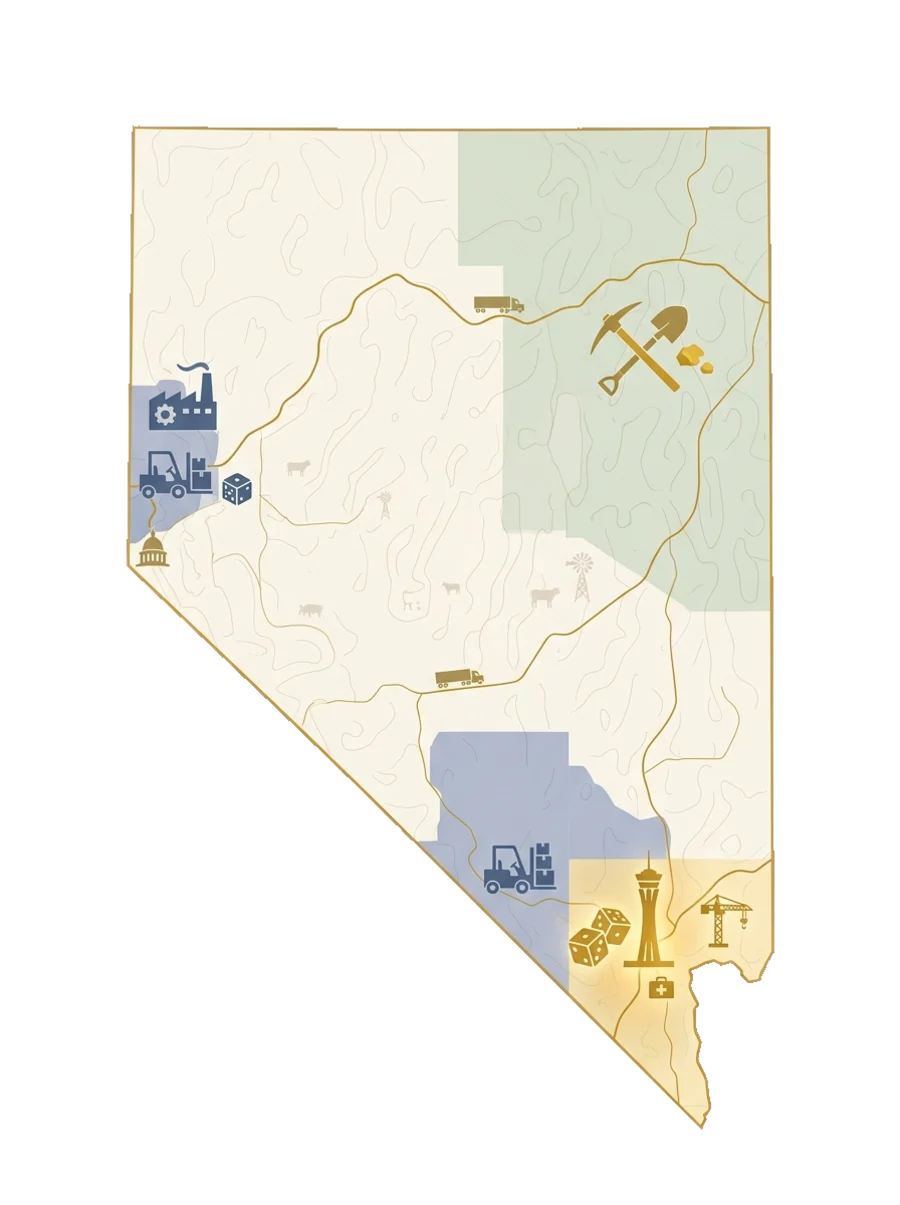
Casinos, hotels, construction crews, and hospitals. Falls, burns, lifting injuries, and long shifts on the busiest floors in Nevada.
Warehouse and distribution country. Forklift strikes, falling stock, and shoulders worn down by the pick line.
Truckers and delivery drivers live on I-15, US-95, and I-80. A wreck on the clock is still a work injury.
Manufacturing and logistics. Machine guards, conveyors, and repetitive motion, plus the casinos downtown.
State workers and union crews. Government employees carry comp coverage like everyone else.
Nevada mines most of America's gold. Heavy equipment and remote sites, a long way from the nearest ER.
Nevada's private employers reported 33,800 workplace injuries and illnesses in 2024, at a rate above the national average, and more than half came out of just two sectors: hospitality, and the trade and transportation cluster that keeps the valley supplied. Whatever badge you wear to work, the claim rules are the same. So are the insurer moves.
Hospitality is more than 1 in 4 jobs in the Las Vegas valley, and casino hotels logged about 5,400 recorded injuries in 2024, more than any other industry in the state's tables. Housekeepers, cooks, dealers, porters, and security get hurt where guests never look.
How repetitive strain claims workNevada's deadliest industry: construction lost 9 workers in 2024, 27 percent of the state total, and roofing crews record some of the highest injury rates the state publishes. Falls and struck by injuries lead the list, from Henderson subdivisions to Strip remodels.
Construction accident claimsWarehouse and transport jobs in the valley have grown about 70 percent in a decade, and warehousing's injury rate runs nearly double the state average. Forklifts, pallet stacks, and pick rate pressure do the damage in the North Las Vegas fulfillment corridor.
Forklift and loading dock injuriesNo Nevada job group lost more workers in 2024 than transportation and material moving: ten deaths, six of them heavy truck drivers. A crash on the clock on I-15 or US 95 is a comp claim, and often a second claim against the driver who hit you.
When someone else caused the crashRoughly 170,000 Nevadans work in hospitals, clinics, and home care, and patient lifting wrecks more backs than any machine. Nurses and CNAs get told the pain is part of the job. It isn't, and comp covers it.
Back injury claimsNevada law presumes heart and lung disease are job related for career firefighters and police officers after two years of service, and covers many firefighter cancers after five (NRS 617.453 to 617.457). These claims follow their own rules, including a faster path to an Appeals Officer.
Occupational disease coveragePublic employees get hurt at a higher rate than Nevada's private workforce, 4.2 cases per 100 workers against 3.0, and most of those injuries land on local government staff. Self insured cities and their administrators fight claims the same way carriers do.
Fighting a denied claimClose to 69,000 Nevadans build everything from batteries to building products. Presses, conveyors, and missing machine guards produce crush and amputation injuries that change a working life in one second.
Amputation and machine injuriesNevada mines about two thirds of America's gold, and mining paid more than 14,500 Nevadans an average of $113,000 a year in 2023. Most of that work happens far from the valley, and we take workers' comp calls from every corner of Nevada.
Catastrophic injury casesRetail crews, kitchen and banquet staff, security guards, landscapers, office workers: the same no fault rules cover them all. If your industry isn't listed here, your claim still counts. Start with our plain guide to Nevada work injuries, or call (702) 360-5000 and ask.
Workers' comp usually stops you from suing your own employer. It does not stop you from going after anyone else who caused your injury. That distinction is easy to miss, and it is often where the real money is, because a third party case can pay for the pain and suffering that comp leaves out entirely.
Picture a few of the ways it shows up around here. A delivery driver gets rear ended on the 215 while making a run for work. A laborer on a Henderson build is hurt by a subcontractor's mistake, not his own crew's. A worker on a Strip property is injured by defective equipment some manufacturer sold. In each one, there is the comp claim against the employer's insurer and a separate injury claim against the outside party. Running both at once, without one undercutting the other, takes some care, and it is the kind of thing people leave on the table when they handle a claim alone. We map that out on our third party work injury page, and for crashes on the clock the overlap with a standard car accident claim matters too.

Comp claims drag on, and the insurer is counting on you getting tired and taking less. It helps to have the same person on your file the whole way, someone who knows your case by name and not by number. Erik handles these himself, from the first call through the rating fight.
You pay nothing up front. Our fee comes out of the recovery, and we go over case costs with you before anything starts.
Injuries do not keep office hours. Call nights, weekends, and holidays. Hablamos Español.
We know the carriers, the hearing officers, and the way Clark County employers and their insurers operate.
"Thank you mr. Severinoand staff for being very friendly and professional which made a very difficult process stress free.from the beginning to the end aall of my concerns weere taken care of quickly.i highly recommend to anyone who needs this type of service you and your staff have my 5 star rating.once again thank you"
Do what you can in order. We handle the rest from there.
Tell your supervisor the same day and keep a copy with the date.
See an authorized clinic so the official claim form gets filed.
Save work restrictions, pay stubs, and any letter the insurer sends.
We watch the deadlines and handle the insurer so you can heal.
Nevada law under NRS Chapter 616 gives you 7 days to notify your employer in writing on the C-1 form, and 90 days to file the C-4 claim form with the insurer. Miss those windows and the insurer can deny on timing alone. Report the injury now and call us so a deadline never decides your case for you.
Every work injury has its own coverage and evidence questions. Start with the one that matches what happened to you.
Tell us what happened on the job. We will tell you, honestly, whether the insurer is treating you fairly and what it would take to fix it. No pressure, no cost, no obligation.
Prefer to call right now?
(702) 360-5000We respond within the hour.
Licensed in Nevada since 2006 (State Bar of Nevada #10221). More than 20 years representing Nevadans against banks, insurers, and large corporations. Every client works directly with Erik, not a rotating cast of case managers.