Hurt In A Bus Accident In Las Vegas?
A bus claim is not a regular crash. The bus might belong to a public agency, a shuttle company, or an out-of-state tour operator, and each one comes with its own insurer and its own clock. Talk to Erik today, before the footage is gone and a deadline decides it for you.
- No fee unless we win your case
- Free, confidential review, available 24/7
- Rated 4.9 across 400+ Google reviews
- A local firm on St. Rose Parkway in Henderson
Talk To Erik Today
Takes about a minute. We respond fast.
We've Got Your Details
Someone from our team will call you shortly. For immediate help call (702) 360-5000.
The First Question Is Whose Bus It Was
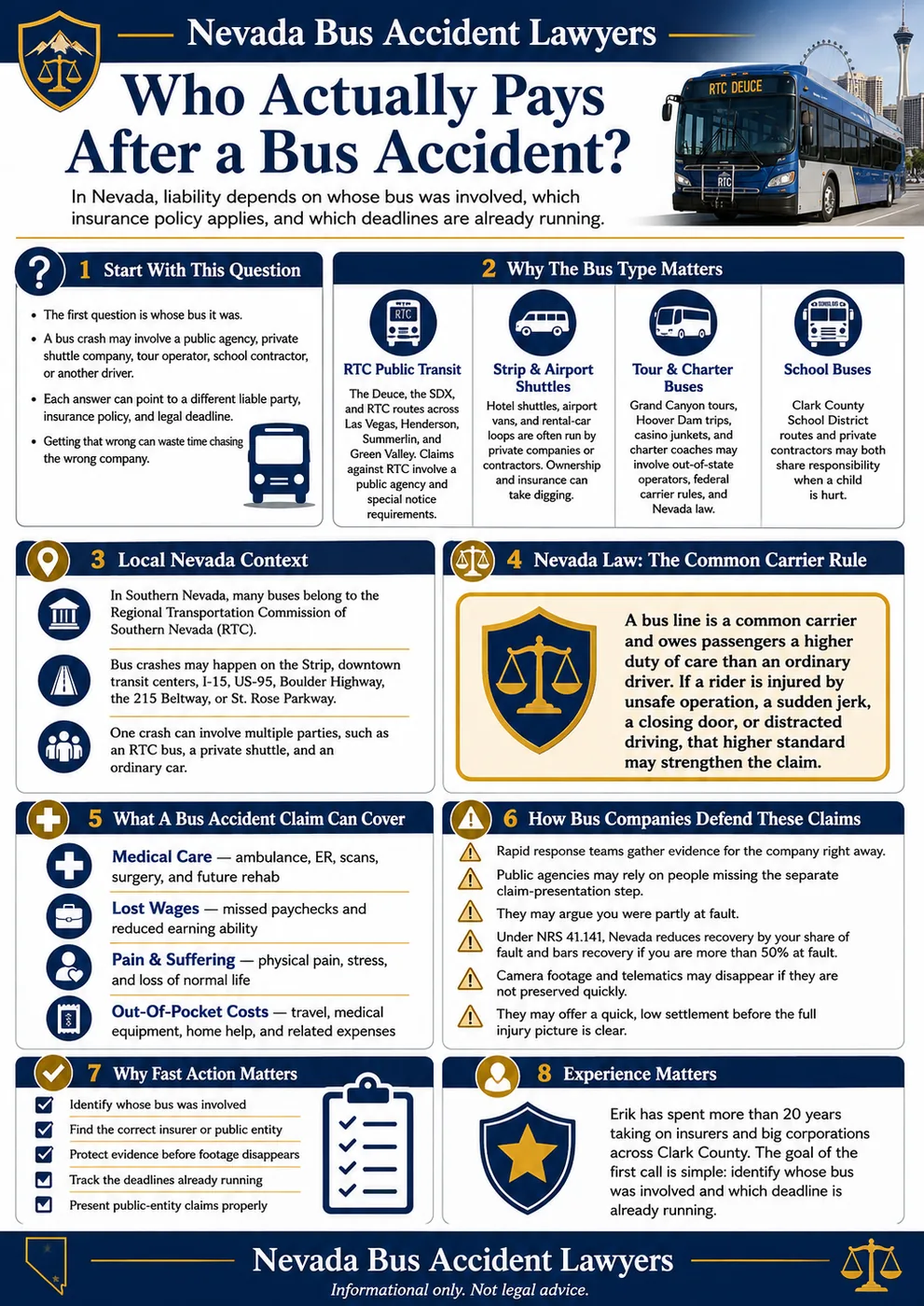
With most crashes, you point at the other driver and their insurer pays. A bus is rarely that simple. The bus that hurt you might be run by a public agency, a private shuttle company, an out-of-state tour outfit, or a contractor working for a school. Each of those answers points to a different liable party, a different insurance policy, and sometimes a completely different set of rules and deadlines. Get that part wrong and you can chase the wrong company for months.
Here in the valley, a huge share of the buses on the road belong to the Regional Transportation Commission of Southern Nevada, the RTC. Their routes run the length of the Strip and reach across Henderson, Summerlin, and Green Valley. A claim against the RTC is a claim against a public body, and Nevada treats those differently than a claim against a private company. There is a claim you have to formally present to the agency before any lawsuit, on top of the regular filing deadline, which is exactly why the bus you were on or the bus that hit you is the first thing we pin down.
Where it happened often tells us a lot. The Deuce and the SDX work Las Vegas Boulevard up and down the Strip, RTC routes feed the transit centers downtown and at Bonneville, and tour and shuttle coaches pour off I-15 and US-95 and along Boulder Highway toward Hoover Dam and the Grand Canyon. A crash on the Strip might involve a public RTC bus, a private hotel shuttle, and an ordinary car all at once, and each one answers to a different policy. A wreck out on the 215 Beltway or St. Rose Parkway near our Henderson office might be a charter coach headed back from a casino run. Same kind of injury, very different claim.
Erik has spent more than 20 years taking on insurers and big corporations across Clark County. He knows how the regional carriers and the public-entity adjusters operate, and how the Eighth Judicial District Court of Clark County tends to handle these cases when they do not settle. The point of the first call is simple: figure out whose bus it was, and which deadline is already running.
"During a hard financial decision the entire staff as well as Erik himself made this an easy solution without making me feel any other way than doing the right thing. Highly recommend"
Four Kinds Of Bus, Four Different Claims
Las Vegas runs more buses than almost any city its size, between transit, the Strip, the airport, and the tour trade. The kind of bus tells us who is on the hook.
RTC Public Transit
The Deuce, the SDX, and the Regional Transportation Commission routes that run the Strip and the valley. A claim here is against a public agency, which means special rules and a shorter window to put them on notice.
Strip And Airport Shuttles
Hotel shuttles, the Harry Reid airport vans, and rental-car loops. These are usually private companies or contractors, and figuring out which one owned the bus and which insurer covers it takes digging.
Tour And Charter Buses
Grand Canyon runs, Hoover Dam tours, casino junkets, and chartered coaches. Many are out-of-state operators, so federal carrier rules and Nevada law can both come into play.
School Buses
Clark County School District routes and the contractors who run some of them. When a child is hurt, both the driver and the entity that put that bus on the road can share the blame.
A Bus Owes Its Riders More Than An Ordinary Driver
Here is a piece of Nevada law that works in a passenger's favor. A bus line is what the law calls a common carrier, a business that carries paying passengers, and common carriers are held to a higher duty of care than a regular driver behind the wheel. When you paid your fare and stepped on board, that company took on a real responsibility for your safety. A sudden jerk that throws you out of your seat, a door that closes on you, a driver staring at a phone: those can each be a breach of that heightened duty.
That higher standard is one reason a passenger's bus case can be stronger than a typical fender bender, and it is one reason these claims are worth handling with care. It also cuts the other way for the company, which is why bus operators and their insurers work hard to argue the driver did everything right, or that you somehow caused your own fall. Our job is to hold them to the standard the law actually sets. If you want to see how a routine crash claim compares, our main car accident page lays out the basics, and our passenger injury page covers riders specifically.
Where The Money Actually Comes From
Whether you were a rider or someone the bus hit, a full claim is a lot more than the first ER bill. Here is what we build it around.
Medical Care
The ambulance, the ER, scans, surgery, and the rehab a doctor says you will still need months from now.
Lost Wages
The paychecks you miss while you heal, plus reduced earning power if you cannot return to the same job.
Pain And Suffering
The physical pain, the sleep you lose, and the parts of your life the crash took away.
Out-Of-Pocket Costs
Travel to appointments, medical equipment, home help, and the bills that pile up while you recover.
The Tactics A Bus Carrier Uses Against You
Bus operators and public agencies do not handle a wreck the way a single driver does. They have safety departments, in-house adjusters, and lawyers on call, and many of them get a rapid response team to the scene fast. That team is not there to help you. It is there to gather the version of events that protects the company, take statements while you are rattled, and start shaping the story before you have even seen a doctor.
The playbook is fairly consistent. With a public agency on the other side, they count on you not knowing about the separate claim-presentation step and hope it slips by. They argue you contributed to your own injury, that you were standing when you should have been seated or that you grabbed the wrong rail, because under NRS 41.141 Nevada reduces your recovery by your share of fault, and bars it entirely if you are more than half to blame. They quietly let the camera footage and telematics cycle out while they ask you for paperwork. And they float a quick, low settlement before anyone knows how badly you are really hurt.
Each of those moves has an answer. We send preservation letters before the footage disappears, we present the public-entity claim the right way, and we wait on the medical picture to settle before we ever talk numbers. If the other side keeps blaming you, our page on uninsured and underinsured coverage explains another path that sometimes applies when a third car was involved.

You Work With The Attorney, Not A Call Center
Bus claims have moving parts that throw a lot of firms: public-entity rules, out-of-state operators, commercial policies, and footage that vanishes if no one moves fast. Erik handles your case himself, from the first call to the final check, so the person making those calls is the lawyer, not a rotating case manager.
No Fee Unless We Win
You pay nothing up front. Our fee comes out of the recovery, and we go over case costs with you before anything starts.
Available 24/7
Crashes do not keep office hours. Call nights, weekends, and holidays. Hablamos Español.
Local To Henderson And Las Vegas
We know the routes, the agencies, and the courts. You can sit across a desk from your lawyer, not a screen.
"The staff , and Erik were extremely helpful , professional, expedient and thorough in handling all my matters. I would highly recommend ."

Most Riders Have No Seat Belt
Buses are heavy, and passengers ride standing or in unbelted seats. Even a hard stop can throw people across the aisle. These are the injuries that bring riders and people hit by buses to our door.
- ✓Head injuries and concussions
- ✓Neck and whiplash injuries
- ✓Back and spine damage
- ✓Broken bones and fractures
- ✓Shoulder and knee tears
- ✓Cuts and lasting scarring
What To Do After A Bus Crash In Las Vegas
You do not have to do all of this perfectly. Do what you can, and we will handle the rest.
Get Checked Out
See a doctor the same day if you can. It protects your health and dates your injuries.
Note The Bus
Write down the route, the bus number, the operator on the side, and the time and stop.
Get Witnesses
Other riders and people at the stop saw it. Grab names and numbers before they scatter.
Say Little
No recorded statement to a bus carrier's rapid response team before you talk to a lawyer.
Call Erik
We send preservation letters and present the public-entity claim the right way, before any deadline runs out.
Under NRS 11.190(4)(e), most Nevada injury claims have a two-year filing deadline. A claim against a public transit agency like the RTC adds a step a private case does not have: you must formally present your claim to the agency's governing body before you can sue. Talk to us early so neither one slips by while you are recovering.
Find The Situation That Fits Yours
A bus case can overlap with a few others, depending on what happened. Start with the one closest to your situation.
Bus Accident Questions, Answered Plainly
Your Next Step Is One Phone Call
Tell us what happened. We will tell you, honestly, whose bus it was, which deadline is running, and whether you have a case. No pressure, no cost, no obligation.
Prefer to call right now?
(702) 360-5000Start Your Free Case Review
We respond within the hour.