Hit By A Self-Driving Car In Las Vegas?
When the car that hurt you had no driver, the company behind it would rather treat you like a software glitch than a person. Erik Severino figures out who actually pays: the fleet operator, the carmaker, the software company, or all three. Talk to Erik today.
- No fee unless we win your case
- Free, confidential review, available 24/7
- Rated 4.9 across 400+ Google reviews
- A local firm on St. Rose Parkway in Henderson
Get Your Free Case Review
Takes about a minute. We respond fast.
We've Got Your Details
Someone from our team will call you shortly. For immediate help call (702) 360-5000.
Driverless Cars Share Our Roads Now
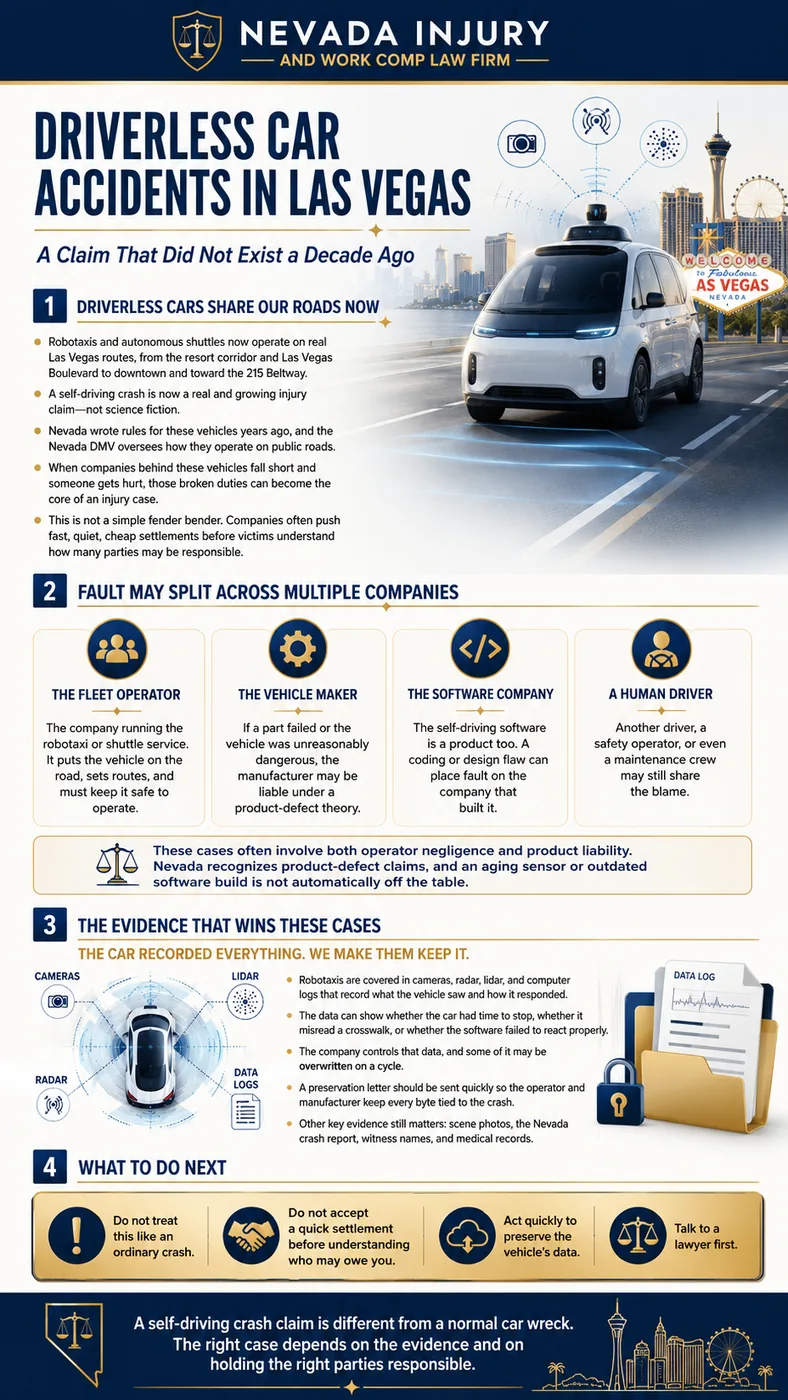
Las Vegas is one of the few American cities where you can be hit by a car that nobody was driving. Robotaxis and autonomous shuttles run real routes here, from the resort corridor along Las Vegas Boulevard to downtown and out toward the 215 Beltway, and the technology keeps spreading. That makes a self-driving crash a real and growing claim, not science fiction. If one hurt you, you are not the first person this has happened to, and you will not be the last.
Nevada wrote rules for these vehicles years ago, and the Nevada Department of Motor Vehicles is the state agency that oversees how they operate on public roads. That framework gives the companies behind these cars specific duties to meet. When they fall short and someone gets hurt, those broken duties become the spine of an injury case. We know where that line sits and how to show a jury when a company crossed it.
What trips people up is the instinct to treat this like a fender bender. It is not. The company that owns the car often responds with a polished claims process designed to settle you quietly, fast, and cheap, before you understand how many parties might owe you. Slow down. Talk to a lawyer first. This page walks through who pays, what the car recorded, the injuries we see, and what to do next.
"Thank you Erik for helping us and for always being very responsive to every single question. Thank you Candace for helping with my file very fast and efficient, we really appreciate your dedication and hard work. I highly recommend them, look no further. They are exceptional."

A Local Lawyer Who Treats Tech Cases Like People Cases
A crash with a self-driving car can feel like you are up against a wall of engineers and corporate lawyers. You should not have to face that alone, and you should not get handed off to a call center either. Erik has been a licensed Nevada attorney since 2006, and he works your case himself, from the first call through the final check.
No Fee Unless We Win
You pay nothing up front. Our fee comes out of the recovery, and we go over case costs with you before anything starts.
Available 24/7
A robotaxi crash does not keep office hours. Call nights, weekends, and holidays. Hablamos Español.
Local To Henderson And Las Vegas
We know these roads, the Clark County courts, and the Nevada agencies that govern these vehicles. You can sit across a desk from your lawyer.
Fault Splits Across Companies, Not One Driver
In a normal crash you point at the driver who caused it. With a self-driving car there is no single driver to point at, so the law looks at the companies that built, ran, and programmed the vehicle. Often more than one of them owes you.
The Fleet Operator
The company that runs the robotaxi or shuttle service in Las Vegas. They put the vehicle on the road, set its routes, and are responsible for keeping it safe to operate.
The Vehicle Maker
If a part failed or the car was built in a way that made it unreasonably dangerous, the manufacturer can be on the hook under a product-defect theory.
The Software Company
The autonomy stack that decides when to brake, turn, and yield is a product too. A coding or design flaw that caused the crash can point fault at whoever wrote it.
A Human Driver
Plenty of these crashes still involve a person behind another wheel, a safety operator who was supposed to take over, or a maintenance crew that missed something.
Two legal theories run side by side in these cases. The first is operator negligence: the fleet company had a duty to run a safe vehicle and did not. The second is product liability: a part, a sensor, or the self-driving software was defective and the defect caused your injury. Nevada recognizes product-defect claims, and a defective autonomous system can fit squarely inside that theory. Worth knowing, unlike some states, Nevada has no general statute of repose that bars a product-defect injury claim just because the hardware is a few years old, so an aging sensor or an outdated software build is not automatically off the table. Layered on top, an ordinary human driver in another car can still be partly to blame.
Pinning down the right mix is the whole job. Name only the operator and the manufacturer walks. Name only the manufacturer and you fight a product case you did not need to. We build the claim around what the evidence actually shows, then hold the right parties responsible. If you were a passenger inside the robotaxi rather than in another car, your path looks different again, and our passenger injury and rideshare crash pages cover that ground.
The Car Recorded Everything. We Make Them Keep It.
This is where a self-driving crash case is won or lost. A robotaxi is covered in sensors: cameras facing every direction, radar, lidar that maps the world in three dimensions, and a computer logging every decision the software made. The vehicle quietly recorded what it saw, when it saw it, whether it braked, and how hard. In a normal crash you fight over fuzzy memories. Here, the truth is sitting on a server.
The problem is who holds that server. The company does. They can review the logs before you ever see them, and data gets overwritten on a cycle. That is why our first move is a preservation letter, a formal demand that the operator and the maker hold every byte of sensor and autonomy data tied to your crash. Send it late and the most important evidence in your case can be gone for good.
Once the data is locked down, it tells a story. It can show the car had a clear line of sight and a full second to stop and chose not to. It can show the software misread a crosswalk or a cyclist. It can also back you up when the operator claims you caused it. We pair that data with the basics that still matter: the scene photos, the Nevada crash report, the witness names, and your medical records. Build that file early and the company stops treating you like a rounding error.
An Autonomous Car Still Hits Like Any Other
A driverless car weighs as much as any sedan, and the harm it does is no gentler. These are the injuries that bring people to us after a self-driving crash.
- ✓Whiplash and neck strain
- ✓Concussion and TBI
- ✓Herniated and bulging discs
- ✓Broken bones and fractures
- ✓Shoulder and knee tears
- ✓Back and spine damage
The Operator's Playbook, And How We Answer It
The companies running these vehicles know they are on new legal ground, so they move fast to control it. Expect a representative to reach out quickly, sound genuinely sorry, and offer to make it easy. The first number they float is built to close your file before you know the full extent of your injuries or how many parties owe you. A signed release the first week is exactly what they want.
Their next play is the data. Because the logs live on their servers, they will frame what happened in the light that favors them, and they will lean on you to settle before any independent eyes review the raw sensor feeds. They may argue the car behaved reasonably and that you, the human, were the unpredictable one. That is why we demand the data and read it ourselves rather than taking their summary on faith.
They will also try to shrink the case by pinning fault on you under Nevada's comparative negligence rule, since every percentage of blame they shift cuts their bill. We push back with the record: the vehicle's own logs, the scene, the witnesses, and your treatment history. If part of the harm traces to a defective component, we keep the manufacturer in the case so no single defendant can hide behind another. For the broader picture on how crash claims work in Nevada, our main car accident page lays out the fundamentals.
"Erick is very humble, Very professional and friendly. Highly recommend!"
Four Moves That Keep Your Case Strong
You do not have to do all of this perfectly. Do what you can, and we will handle the rest.
Get Checked Out
See a doctor the same day if you can. It protects your health and dates your injuries to the crash.
Note the Vehicle
Photograph the car, any branding or fleet markings, the plate, and the spot. It identifies the operator.
Report It
Call the police and get the event number. A Nevada crash report pins down the basics fast.
Call Erik
We send the data preservation letter and deal with the company so the logs are not lost.
Under NRS 11.190, you generally have two years from the crash to file an injury lawsuit. A product-defect claim against a manufacturer can carry its own timing, and the sensor data can disappear far sooner. Talk to us early so neither a deadline nor a deleted log decides your case for you.
Other Cases We Handle Across Clark County
Every kind of crash has its own fault questions and its own evidence. If yours does not quite fit a robotaxi case, start with the one that matches what happened to you.
Self-Driving Crash Questions, Answered Plainly
Where To Go From Here
Tell us what happened. We will tell you, honestly, whether you have a case, who is likely on the hook, and what it would take to handle it. No pressure, no cost, no obligation.
Prefer to call right now?
(702) 360-5000Start Your Free Case Review
We respond within the hour.