
Your Workers Comp Claim Was Denied. You Can Still Fight It.
A denial letter is not the end. In Nevada you have the right to appeal, but the clock starts the day that letter is mailed. Erik Severino has spent 20+ years taking on insurers and big corporations, and he gets denied claims reopened and cut-off checks turned back on.
- No fee unless we win your case
- Free, confidential review, available 24/7
- Rated 4.9 across 400+ Google reviews
- A local firm on St. Rose Parkway in Henderson
Get Your Free Appeal Review
Bring your denial letter. We respond fast.
We've Got Your Details
Someone from our team will call you shortly. For immediate help call (702) 360-5000.
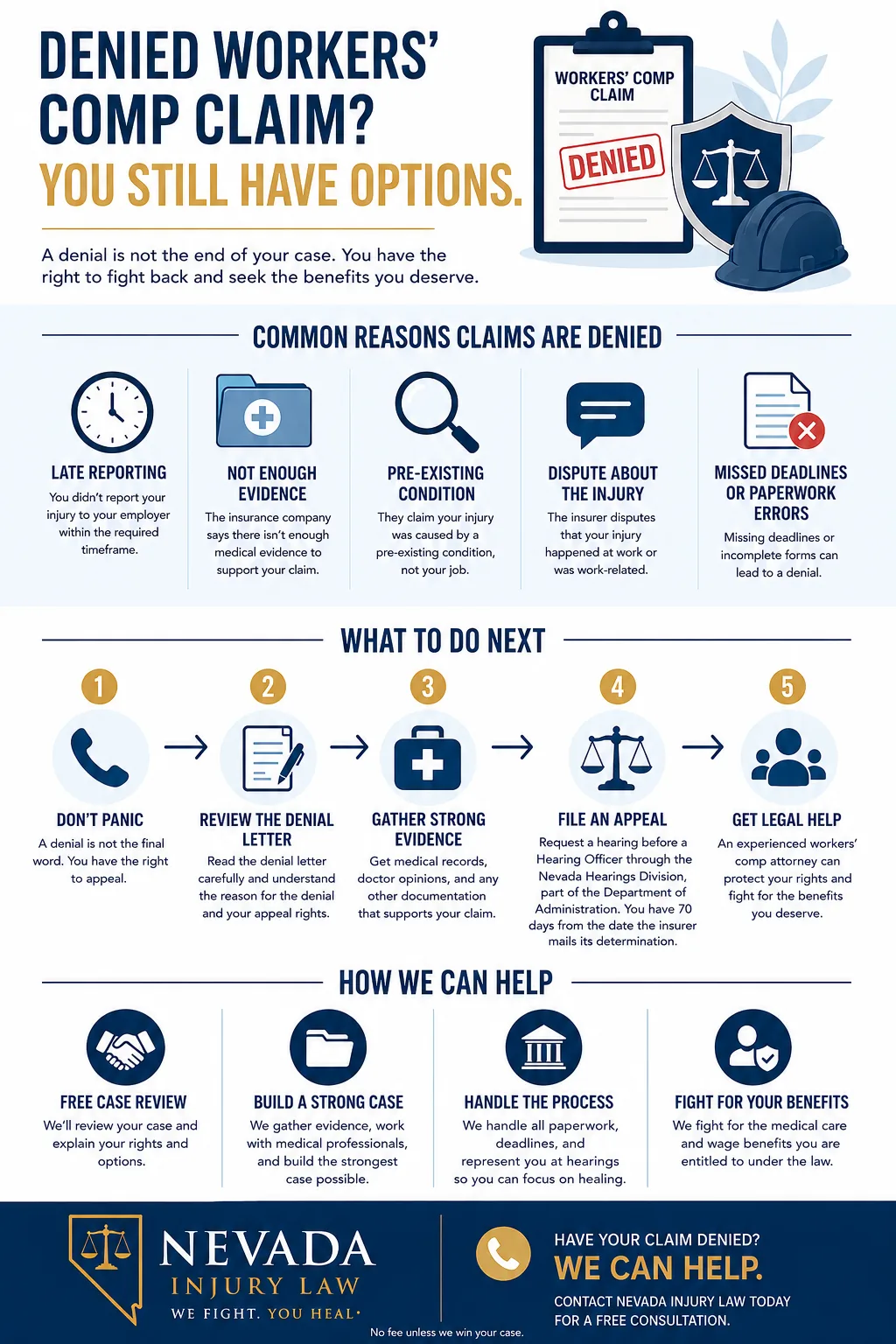
Getting Denied Is Common. Losing Is Not Required.
You got hurt on the job, you did what you were told, and then a letter showed up saying no. Claim denied. Maybe the checks you were counting on just stopped. It feels like the system already decided you do not matter, and that is exactly what the insurer is hoping you believe.
Here is the part the letter does not say in big print: Nevada gives you the right to appeal, and a lot of denials get reversed once someone puts the right medical proof in front of the right person. The insurer counts on workers reading that letter, feeling beaten, and walking away. Plenty of people do. You do not have to be one of them.
Nevada workers' comp is a no-fault system under the Nevada Industrial Insurance Act, overseen by the Division of Industrial Relations.No-fault means you do not have to prove your employer did anything wrong to be covered. The trade-off is a strict set of forms and deadlines, and a single missed step gives the insurer an easy reason to say no. You report the injury to your employer on a C-1 within 7 days, and a C-4 claim gets filed with the insurer within 90 days, usually signed at your treating doctor's office.
The catch is time. You have 70 days from the date stamped on the determination letter to request a hearing, and once it passes, the door can close for good.That is why the smartest thing you can do the day a denial lands is figure out the deadline and start the appeal. We do that part with you, for free, before you owe anyone a dime.
"Handled my case very efficiently and professionally. Answered any questions I had in a timely manner. Things were handled quickly and painlessly. Staff are very knowledgeable and respectful."

The Insurer Has A Team. You Should Too.
By the time a denial reaches your mailbox, the insurer already has an adjuster, a hired doctor, and often a defense lawyer lined up to keep it that way. Going into a hearing alone against that is a hard fight. Erik has worked these appeals across Clark County since 2006, and he handles your case himself instead of handing you off to a call center.
No Fee Unless We Win
You pay nothing up front. Our fee comes out of the recovery, and we go over case costs with you before anything starts.
Available 24/7
Deadlines do not wait for office hours. Call nights, weekends, and holidays. Hablamos Español.
Local To Henderson And Las Vegas
We know the state Hearings Division, the Appeals Officers, and how Clark County insurers operate. You can sit across a desk from your lawyer.
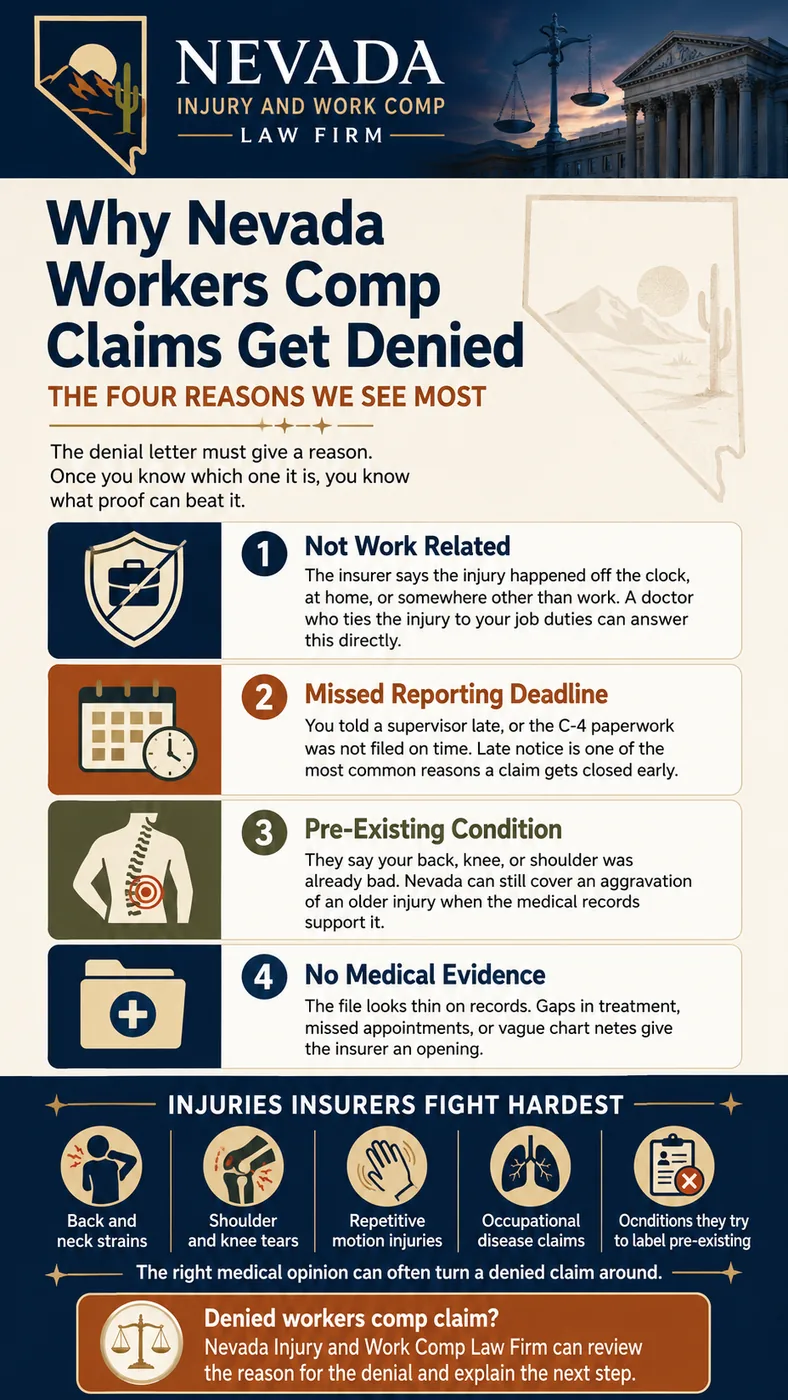
Why Nevada Workers Comp Claims Get Denied
The denial letter has to give a reason. Once we know which one it is, we know what proof beats it. Here are the patterns that show up again and again.
Not Work Related
The insurer claims your injury happened off the clock, at home, or somewhere other than the job. A doctor who ties the injury to your work duties answers this head on.
Missed Reporting Deadline
You told your supervisor late, or the C-4 paperwork never got filed on time. Late notice is one of the most common reasons a file gets closed before anyone reads it.
Pre-Existing Condition
They say your back, knee, or shoulder was already bad. Nevada still covers an aggravation of an old injury, so this denial is often beatable with the right records.
No Medical Evidence
The claim got denied because the file looked thin on records. Gaps in treatment, a missed appointment, or vague chart notes give the insurer an opening they will use.
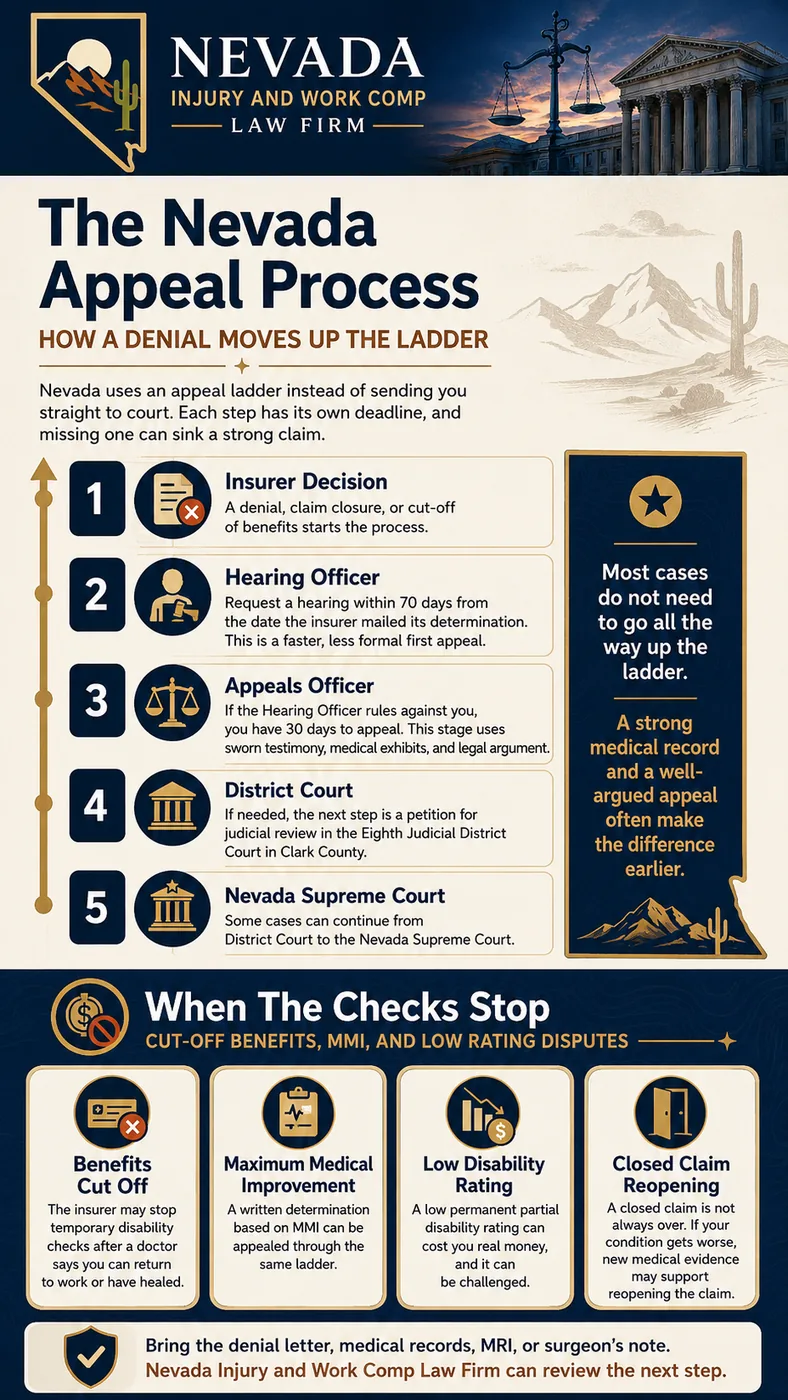
How A Denial Moves Up The Ladder
Nevada does not make you sue in court to fight a denial. Instead, the dispute runs through a state appeal ladder built into NRS Chapter 616C, and each rung is a fresh chance to win. The trick is that every step has its own deadline, and skipping or missing one can sink an otherwise strong case.
The first stop is a Hearing Officer, through the State of Nevada Hearings Division, part of the Department of Administration. You have 70 days from the date the insurer mails its determination to request that hearing.It is a faster, less formal proceeding where you explain why the denial is wrong and put your records in. If the Hearing Officer rules against you, you have 30 days to move the claim to an Appeals Officer, who runs a full evidentiary hearing with sworn testimony, medical exhibits, and legal argument.That is the stage where having a lawyer matters most.
If the Appeals Officer still rules against you, the path leads to a petition for judicial review in the Eighth Judicial District Court of Clark County, the courthouse on East Lewis Avenue in downtown Las Vegas, and from there potentially to the Nevada Supreme Court.Most cases never go that far. A solid medical record and a well-argued appeal often turn things around at the Hearing Officer or Appeals Officer level. If your underlying injury involves a repetitive stress condition or an occupational disease, the medical proof needed to win the appeal looks a little different, and we tailor it to your facts.
Cut-Off Benefits, MMI, And Low Rating Disputes
Not every fight starts with a flat denial. Sometimes the claim was accepted, the checks came for a while, and then one day they stopped. The insurer declares you at maximum medical improvement, says you can go back to work, or closes the claim. Each of those moves is a written determination, and each one can be appealed on the same ladder a denial uses.
A common pattern: the insurer sends you to a doctor it chose, that doctor writes that you are healed or can return to light duty, and the temporary total disability checks end based on that report. Your own treating doctor may strongly disagree. We put both opinions in front of the Hearing Officer and argue why the insurer-chosen exam should not control your future.
Then there is the rating. Once you reach maximum medical improvement, a rating physician assigns a permanent partial disability percentage, and that number drives a big part of what you are owed. A rushed exam or a lowball percentage can cost you real money, and you have the right to challenge it. How a rating turns into a payout is something we walk through on our workers comp settlement page, and if a third party outside your employer played a role, our third-party work injury page covers that path too.
A closed claim is not always a dead claim. If your condition gets worse after the file is shut, Nevada lets you ask to reopen it with proof of a change in your condition or new medical evidence.A strict one-year bar applies only in a narrow situation, claims that never met the minimum disability period and that got no permanent partial disability award, so most workers have more room than they think. We see this a lot with backs and shoulders that flare up months after a worker went back to a warehouse off the 215 Beltway or a job site near the airport. Bring us the new MRI or the surgeon's note and we will tell you whether a reopening request has a real shot.
The Injuries Insurers Fight Hardest
Denials cluster around injuries that are easy to blame on something else. Back and neck strains, shoulder and knee tears, repetitive motion damage, and conditions that build up over time are the ones insurers love to call pre-existing. If your back injury or another hard-to-see injury got denied for that reason, the right medical opinion often turns the denial around.
"Thank you very much, Erik and staff, for the very responsive and professional service my husband and I received in the last few months. We found Erik in the last quarter of 2019, but we started the process of filing our petition in February 2020. Shortly after, the COVID lockdown happened, and the process halted, but all through the months before the re-opening, we communicated with Erik and he had always responded to us assuringly. When the courts opened, his team worked with us fast. Erik, Gus, and Michelle) were with us every inch of the way, until we received a favorable decision. Thanks again with lots of grace and gratitude."
Four Moves That Protect Your Appeal
You do not have to do all of this alone. Do what you can, and we will handle the filings.
Save The Letter
Keep the denial or cut-off letter and note the date on it. That date starts your appeal clock.
Keep Treating
Do not stop seeing your doctor. Gaps in care are the first thing the insurer uses against you.
Gather Records
Pull together your C-4 forms, work notes, pay stubs, and every medical record you can find.
Call Erik
We figure out the deadline, file the request for hearing, and build the medical proof to win it.
Under NRS Chapter 616C, you have 70 days from the date the insurer mails its written determination to request a hearing before a Hearing Officer, and the clock runs from that mailing date, not the day you open the envelope.If a Hearing Officer rules against you, the next step is a 30-day window to reach an Appeals Officer.Miss a deadline and you can lose the right to appeal. Talk to us the day your letter arrives so a deadline never decides your case for you.
More On Your Nevada Work Injury Rights
A denied claim usually sits inside a bigger work injury story. These pages cover the parts that connect to yours.
Denied Claim Questions, Answered Plainly
Talk To Erik Before Your Deadline Passes
Bring the letter. We will read it with you, find the deadline, and tell you honestly whether the denial can be beaten. No pressure, no cost, no obligation.
Prefer to call right now?
(702) 360-5000Start Your Free Appeal Review
We respond within the hour.