
Rear-Ended In Las Vegas? You Probably Have A Case.
The driver who hits you from behind is usually the one at fault, and their insurer knows it. So they pivot to the next move: calling your injury minor and your bumper damage too small to matter. No fee unless we win, and Erik Severino has spent 20+ years taking on insurers and big corporations, answering that exact playbook.
- No fee unless we win your case
- Free, confidential review, available 24/7
- Rated 4.9 across 400+ Google reviews
- A local firm on St. Rose Parkway in Henderson
Get Your Free Case Review
Takes about a minute. We respond fast.
We've Got Your Details
Someone from our team will call you shortly. For immediate help call (702) 360-5000.

A Local Lawyer Who Knows These Freeway Crashes
Rear-end cases look simple from the outside, and that is exactly why they go sideways. The other side leans on the bumper photo, the soft-tissue label, and a quick lowball offer before you know how hurt you really are. Erik has spent more than 20 years taking on insurers and big corporations across the valley, from stop-and-go pileups on I-15 to the merge crunches near the Spaghetti Bowl. He knows the move before the adjuster makes it.
No Fee Unless We Win
You pay nothing up front. Our fee comes out of the recovery, and we go over case costs and expenses with you before anything starts.
Available 24/7
Crashes do not keep office hours. Call nights, weekends, and holidays. Hablamos Español.
You Work Directly With Erik
No rotating case managers and no call center. Erik handles your case himself, from the first call to the final check.
Why The Following Driver Usually Pays
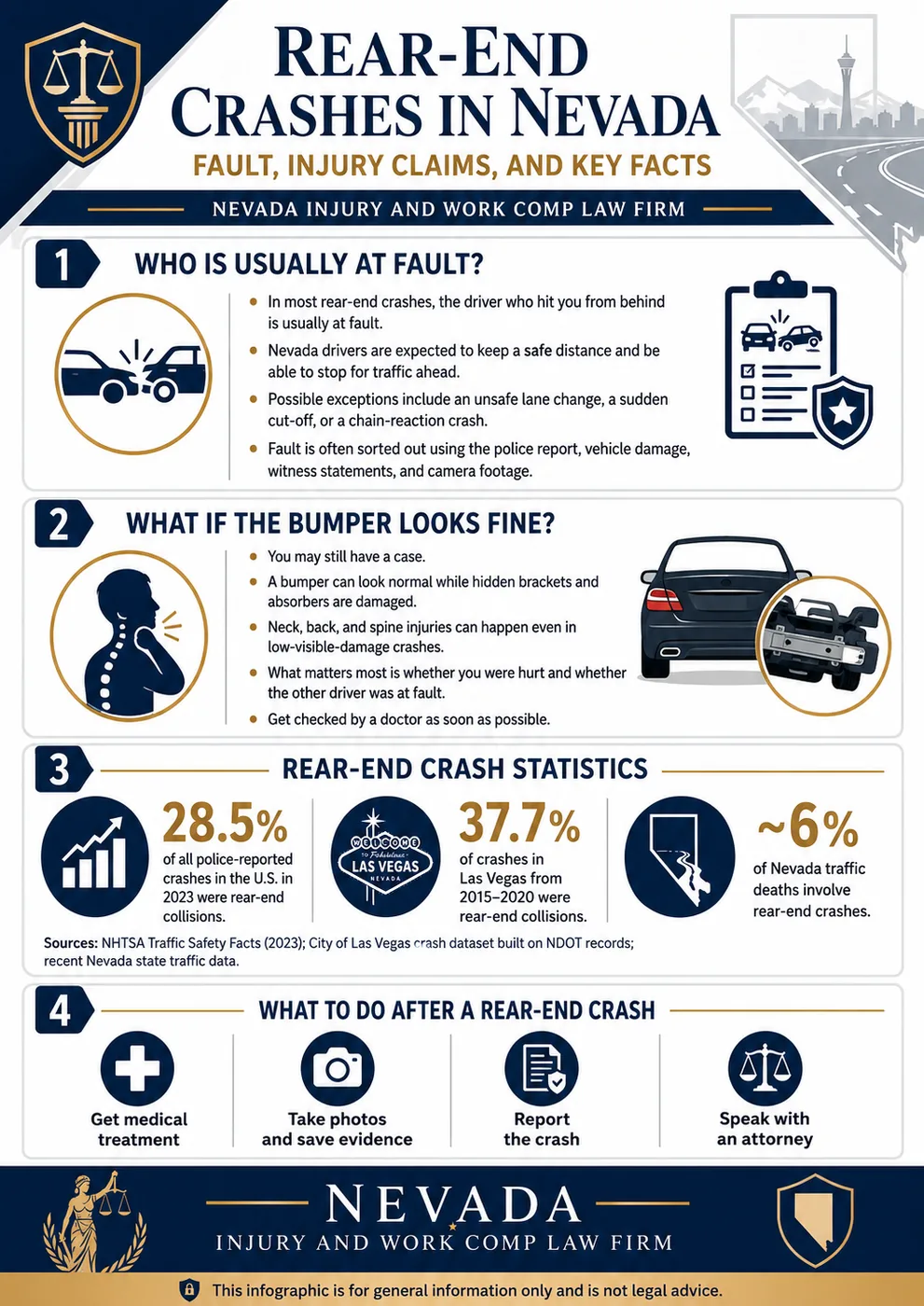
Nevada wrote the rule down. Under NRS 484B.127, a driver may not follow another vehicle "more closely than is reasonable and prudent," accounting for speed, traffic, and road conditions. When someone tailgates or looks down at a phone and plows into the back of your car, that statute is usually the reason the blame lands on them. A police officer writing up the crash often starts from the same place, which is why rear-end claims so often begin with a strong fault picture in your favor.
It is a presumption, though, not an automatic win. The other driver gets to argue it was not their fault, and there are real situations where that holds up. A sudden unsafe lane change that left them no room, a brake-check meant to provoke a hit, a lead car with broken brake lights, or a chain reaction that shoved one car into the next. Each of those is a defense the insurer will reach for, and each one has an answer if you have the evidence to back it up.
That is the work. We pin down the following distance, the speed, and the sequence of impacts so the story matches what actually happened on the road. When the facts are clear, the rear-driver presumption does a lot of heavy lifting, and the insurer has far less room to wiggle out of paying.
Rear-End Crashes, By The Numbers
No other crash type comes close. Rear-end collisions lead the national count year after year, and the local data runs even higher than the national share. They are rarely the deadliest crashes on the road. They are the ones people survive, hurt, and then have to fight an insurer over, which is exactly why this page exists.
Rear-End Is Crash Type Number One Here
Share of all crashes in the City of Las Vegas by collision type, from the city's public crash dataset built on NDOT crash records, 2015 through 2020. More than one crash in three is a rear-end hit.
Sources: City of Las Vegas open crash data, NDOT-sourced, 70,888 crashes within city limits, 2015 to 2020; NHTSA Traffic Safety Facts 2023, Table 29 (rear-end 28.5% of 6,138,359 police-reported crashes, 461,282 injury crashes); Nevada Traffic Safety Crash Facts, fatal crashes by type, 2017 to 2021. Shares are of each dataset's own crash total.
The Jolt Goes Through Your Neck, Not The Bumper
A rear-end hit snaps your head back and then forward in a fraction of a second. Your spine absorbs that whip even at low speed, which is why people walk away from a fender-bender and wake up the next morning unable to turn their head. Here is what brings most rear-end clients to our door.
Whiplash And Neck Strain
The signature rear-end injury. The head whips back and forward faster than muscles can brace.
Herniated And Bulging Discs
The jolt compresses the spine, and a damaged disc can press on nerves for months.
Concussion And Mild TBI
Your brain does not need to hit the wheel. The whip alone can concuss.
Shoulder And Rotator Cuff Tears
The locked seatbelt saves your life and wrenches the shoulder doing it.
Lower Back And Lumbar Injuries
Sprains, strains, and facet joint damage that flare every time you sit or lift.
Headaches And Dizziness
Post-crash headaches, vertigo, and fog that make desks and screens unbearable.
Jaw And TMJ Injuries
The snap can strain the jaw joint, making chewing and talking hurt.
Wrist And Hand Sprains
Braced hands on the wheel take the transferred force of the hit.
Knee And Dashboard Injuries
Knees drive into the dash or column, bruising bone and tearing cartilage.
Seatbelt And Airbag Injuries
Chest bruising, rib injuries, and abrasions from the equipment that kept it from being worse.
"I called several offices before choosing to go with Erik and his team. Print to answer to phone and all my questions before getting started. The other offices were more worried about me paying fee before being helped. They cruised me through the process of what to get them and they took the reins and held my hand the whole time. Thank you Ciara for taking the time to break down in detail everything from start to finish. Now 3 months later I can work on building myself up again. Cheers to many years of success, you proved it to me!!!"
The Low-Impact, Low-Injury Argument
Once fault is hard to dodge, the insurer changes the subject from who caused the crash to how hurt you really are. The phrase you will hear, in one form or another, is low-impact, low-injury. The idea they push is that a small dent could not possibly cause a real injury, so your claim must be inflated. It is a tidy argument, and it is wrong more often than not.
Here is how the script tends to run. First the adjuster points at the bumper and the repair estimate. Then they flag any gap between the crash and your first doctor visit. Then they pull your old records looking for a stiff neck or a sore back from years ago to call your injury pre-existing. Then comes a fast, friendly offer designed to close your file before you understand how long your recovery will take.
Medical evidence is what answers all of it. A same-day exam, imaging when it is warranted, steady treatment, and a doctor who connects your symptoms to the crash. Soft-tissue injuries are real even when an X-ray looks clean, and a clear treatment record is far more convincing than a body-shop quote. We build that record on purpose, so the low-impact line does not get to be the last word on your health.
Dashcam, Black Box, And The Paper Trail
The cleanest way to shut down a fault dispute is footage. More cars and ride-share drivers on Boulder Highway and the 215 run dashcams now, and a few seconds of video showing the following distance, the brake lights, and the moment of contact can end an argument the adjuster wanted to drag out. The catch is that dashcam files loop and record over themselves, so they have to be saved early.
The vehicles themselves keep a record too. Many cars store crash data in an event data recorder, sometimes called the black box or ECM, which can log speed, braking, and throttle in the seconds before impact. That data can confirm the other driver never hit the brakes, or that they were going faster than they claim. It gets wiped or lost once a car is repaired or scrapped, so timing matters.
Beyond the electronics, the ordinary record still carries weight. The police event number, photos of both cars and the road, the crush pattern that shows the order of impacts in a chain reaction, the names of anyone who saw it, and your medical notes. We send preservation letters and gather all of it while it is still there to gather. Here is what we ask people to hang onto right away.
- Photos of both vehicles, the lane, and any skid marks or debris.
- The police report event number and the other driver's information.
- Your dashcam memory card, pulled before the file loops over.
- Names and numbers of passengers and any witnesses.
- Every medical record, bill, and discharge note from day one.
What A Full Claim Covers
Nevada is a fault state, so the driver who caused the crash (really, their insurer) pays for the harm. A complete claim reaches past the ER bill into the costs that pile up while you heal.
Medical Care
The ER trip, imaging, physical therapy, injections, and any care a doctor says you will still need.
Lost Pay
Wages you missed while healing, plus reduced earning power if you cannot return to the same job.
Pain And Suffering
The daily pain, the lost sleep, and the things you cannot do the way you used to.
Vehicle Damage
Repair or replacement of your car, a rental while yours is in the shop, and towing.
What Moves A Rear-End Settlement Up Or Down
Any page that promises you a number is guessing, and any lawyer who quotes one before reading your medical records is selling. What we can tell you honestly is what the market looks like and which levers set the price. The Insurance Information Institute puts the average bodily injury liability claim at $28,278 for 2024, using industry claims data. Nevada's required coverage floor under NRS 485.185 is $25,000 per person. Read those two numbers together: an average injury claim already outruns a minimum policy, and a herniated disc with injections or surgery leaves it far behind. Finding every dollar of available coverage is not a detail. It is often the whole case.
The Levers That Build Value
- A same-day exam and a steady, documented course of treatment
- Imaging and a doctor who connects the crash to the injury in writing
- Future care, lost wages, and reduced earning power priced in, not skipped
- Every policy on the table: the at-fault driver's, an employer's, and your own UM and UIM coverage
- A file built to try, because insurers price the risk of a courtroom
The Mistakes Adjusters Count On
- A gap between the crash and your first doctor visit
- A recorded statement given while you were still rattled
- Comparative-fault points conceded under NRS 41.141, each one trimming the recovery
- Accepting the first offer before anyone knows what recovery costs
- Dashcam and black-box evidence lost because nobody preserved it
In a Martindale-Nolo survey of personal injury claimants published in 2017, people who hired an attorney reported receiving an average of $77,600, against $17,600 for those who settled on their own. Those are self-reported outcomes across very different cases, not a promise about yours. The honest takeaway is narrower: represented claims tend to be built, documented, and priced differently than unrepresented ones.
Past results do not guarantee a similar outcome. Each case is unique. Our fee is contingent: no fee unless we win, with case costs explained before anything starts. See our settlement process page for how the number actually gets negotiated.
Two Spaghetti Bowls, And The Stop-And-Go Between Them
Nevada named two different freeway interchanges after tangled pasta, and both earn it. Stop-and-go weaves are where following distance disappears, and Erik is licensed statewide, so the crash decides the courthouse, not whether we take the case.
The Downtown Spaghetti Bowl And I-15
The I-15 interchange with US 95, now also signed I-11, has carried around 300,000 vehicles a day, the busiest stretch of highway in Nevada even after its billion-dollar rebuild. Add the Strip corridor ramps and Boulder Highway's signals and you have the valley's rear-end factory.
The Henderson Interchange, Mid-Rebuild
The US 95 and I-215 interchange by Lake Mead Parkway, Henderson's own Spaghetti Bowl, moved about 191,000 vehicles a day before its half-billion-dollar reconstruction began in 2024. Construction zones compress traffic, and compressed traffic ends in rear bumpers. Our office sits minutes away on St. Rose Parkway.
The Original Spaghetti Bowl
Nevada's first use of the nickname, back in 1973, belonged to Reno's I-80 and I-580 interchange. It carries roughly 260,000 vehicles a day through a design built for a third of that, with crash rates in the project area found at up to 150 percent of the statewide average, and its rebuild is running in phases for years to come.
Five Moves That Keep A Rear-End Case Strong
You do not have to do all of this perfectly. Do what you can, and we will handle the rest.
See A Doctor
Same day if you can. It protects your health and dates your whiplash to the crash.
Report It
Call the police and get the event number. The report pins down who rear-ended whom.
Save The Footage
Pull your dashcam card before it loops, and grab photos and witness names.
Say Little To Adjusters
No recorded statement and no quick settlement before you have talked to a lawyer.
Call Erik
We preserve the ECM data and the video and deal with the insurers from day one.
Under NRS 11.190, you generally have two years from the crash to file a rear-end injury lawsuit. Claims involving a government vehicle have a special claim procedure. Talk to us early so a deadline never decides your case for you.
"Erik and his team are the definition of first class. Erik genuinely cares and that was evident from the first time I met him. His office was professional, communicative, and always made me feel like the most important person in the world. They are some of the best in the game"
Find The Page That Fits What Happened
A rear-end hit is one kind of crash, and yours may overlap with others. Start with the situation that matches your day.
Rear-End Crash Questions, Answered Plainly
Talk To Erik About Your Crash
Tell us what happened. We will tell you, honestly, whether you have a case and what it would take to handle it. No pressure, no cost, no obligation.
Prefer to call right now?
(702) 360-5000Start Your Free Case Review
We respond within the hour.