A Single-Vehicle Crash in Las Vegas Can Still Be Someone Else's Fault
You went off the road and no other car was hit, so you assume the claim ends with you. It often doesn't. A bad road, a failed tire, or a driver who ran you off and kept going can all put a defendant on the other side. Talk to Erik today and find out who actually owes you.
- No fee unless we win your case
- Free, confidential review, available 24/7
- Rated 4.9 across 400+ Google reviews
- A local firm on St. Rose Parkway in Henderson
Talk to Erik Today
Takes about a minute. We respond fast.
We've Got Your Details
Someone from our team will call you shortly. For immediate help call (702) 360-5000.
Why a One-Car Wreck Still Needs a Hard Look
Here's the part most people get wrong about a single-vehicle crash. The wreck looks like it's all on you because no other car was hit. So you blame yourself, the insurer agrees, and the file closes before anyone asks the real question: what put your car off the road in the first place?
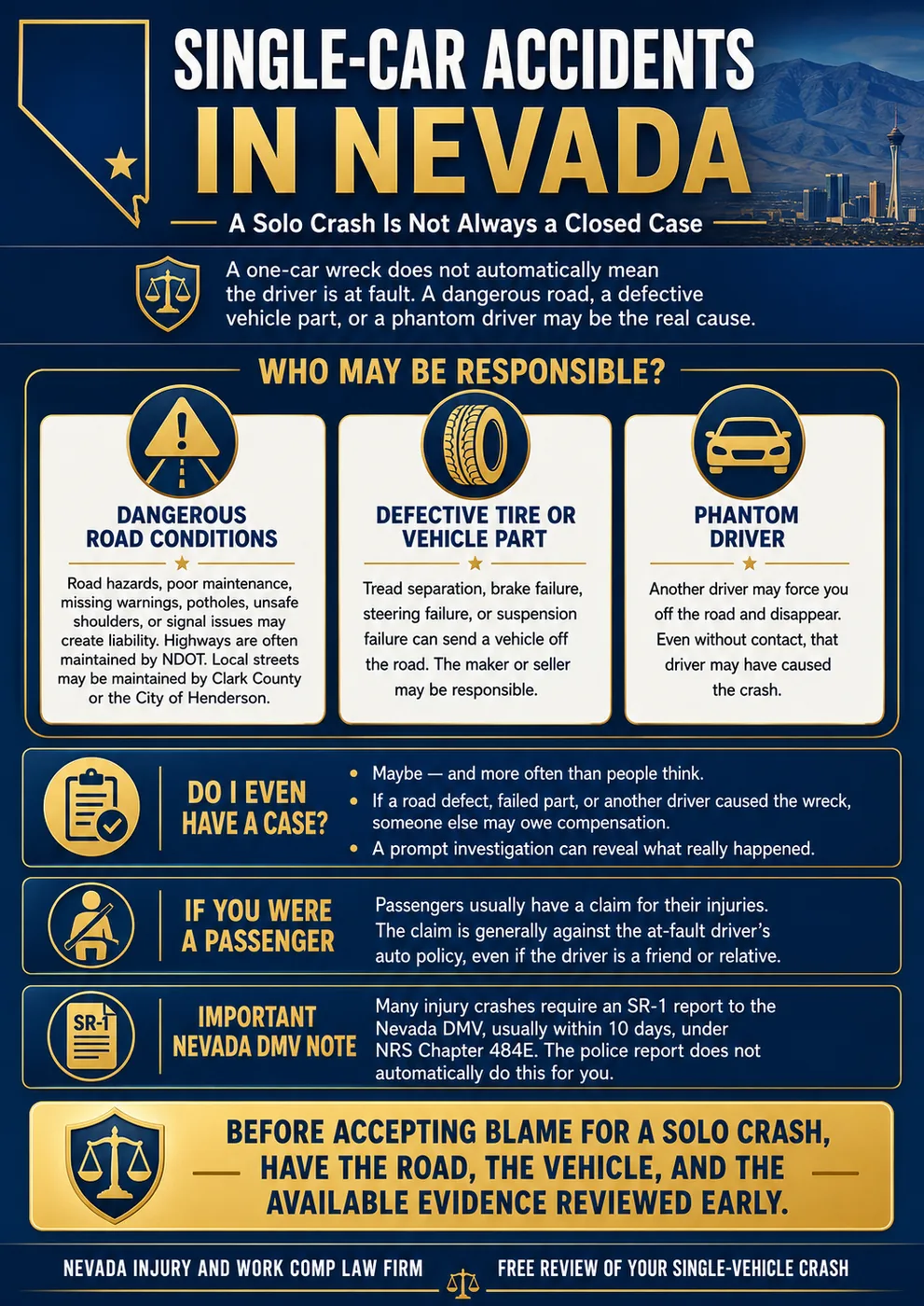
That question opens up a list of people who might owe you. A road agency that left a hazard in place. A company that built or sold a tire or a part that failed. A driver who swerved into your lane, ran you onto the shoulder, then disappeared. In Nevada, the road itself is often run by the Nevada Department of Transportation on the highways and by Clark County or the City of Henderson on local streets, and each one can be held to account when a dangerous condition causes a crash.
This is the kind of claim that needs someone digging early. Erik Severino has spent more than 20 years taking on insurers and big corporations across Clark County, on everything from a routine car accident claim to the tougher solo wrecks. He knows which agency owns which stretch of road, how the Nevada DMV crash data and maintenance records fit together, and how the Eighth Judicial District Court tends to treat a dangerous-condition claim when it doesn't settle. Before you accept that a solo crash was your fault, let someone actually check.
"Great team with great communication. Highly recommend."

The Attorney Works Your File, Not a Call Center
Single-vehicle claims aren't the easy ones. There's no other driver to point at, so the work falls on proving a road was dangerous or a part failed, and that takes a lawyer who actually digs in. At a lot of firms you'd be handed off to a rotating cast of case managers. Here, Erik handles your case himself, from the first call to the final check.
No Fee Unless We Win
You pay nothing up front. Our fee comes out of the recovery, and we go over case costs with you before anything starts.
Available 24/7
Crashes don't keep office hours. Call nights, weekends, and holidays. Hablamos Español.
Local to Henderson and Las Vegas
We know which agency owns which road and how the regional insurers operate. You can sit across a desk from your lawyer.
Four People Who Might Owe You After a Solo Crash
A single-vehicle wreck usually has more than one possible defendant. Here are the four we look at first, and the kind of proof each one takes.
A Dangerous Road or Bad Design
A pothole nobody fixed, a missing guardrail, a curve with no warning sign, flooding where drainage failed, or a work zone left unsafe. When a public road put you in danger, the agency that owns it can be on the hook.
A Defective Tire or Part
A tread that peeled off the belt, a steering or brake part that failed, a tire that was past its safe age when it was sold. When a part fails and sends you off the road, the maker or seller can answer for it.
A Phantom Driver Who Ran You Off
Someone cut into your lane, forced you onto the shoulder, then kept driving. You never touched them, but they caused the wreck. Your own uninsured motorist coverage is built for exactly this.
A Driver You Were Riding With
If you were the passenger, the person behind the wheel had a duty to drive safely. When their choices put you in the hospital, you have a claim against their insurance, even though they are a friend or family.
Suing a Road Agency Has Its Own Rules
When a public road causes a crash, you're not chasing a private driver. You're filing against a government body, and that changes the rules. The Nevada Department of Transportation maintains the interstates and state highways like I-15, US-95, and the 215 Beltway. Clark County and the cities maintain the surface streets, the arterials like Boulder Highway, and the signals at the intersections.
To win one of these, we have to show the agency knew, or should have known, about the danger and didn't fix it in a reasonable time. That means pulling maintenance logs, prior complaints, work orders, and inspection records. A pothole someone reported three months before your crash is a very different case than one that opened the night before. The records tell that story, and the agency won't volunteer them.
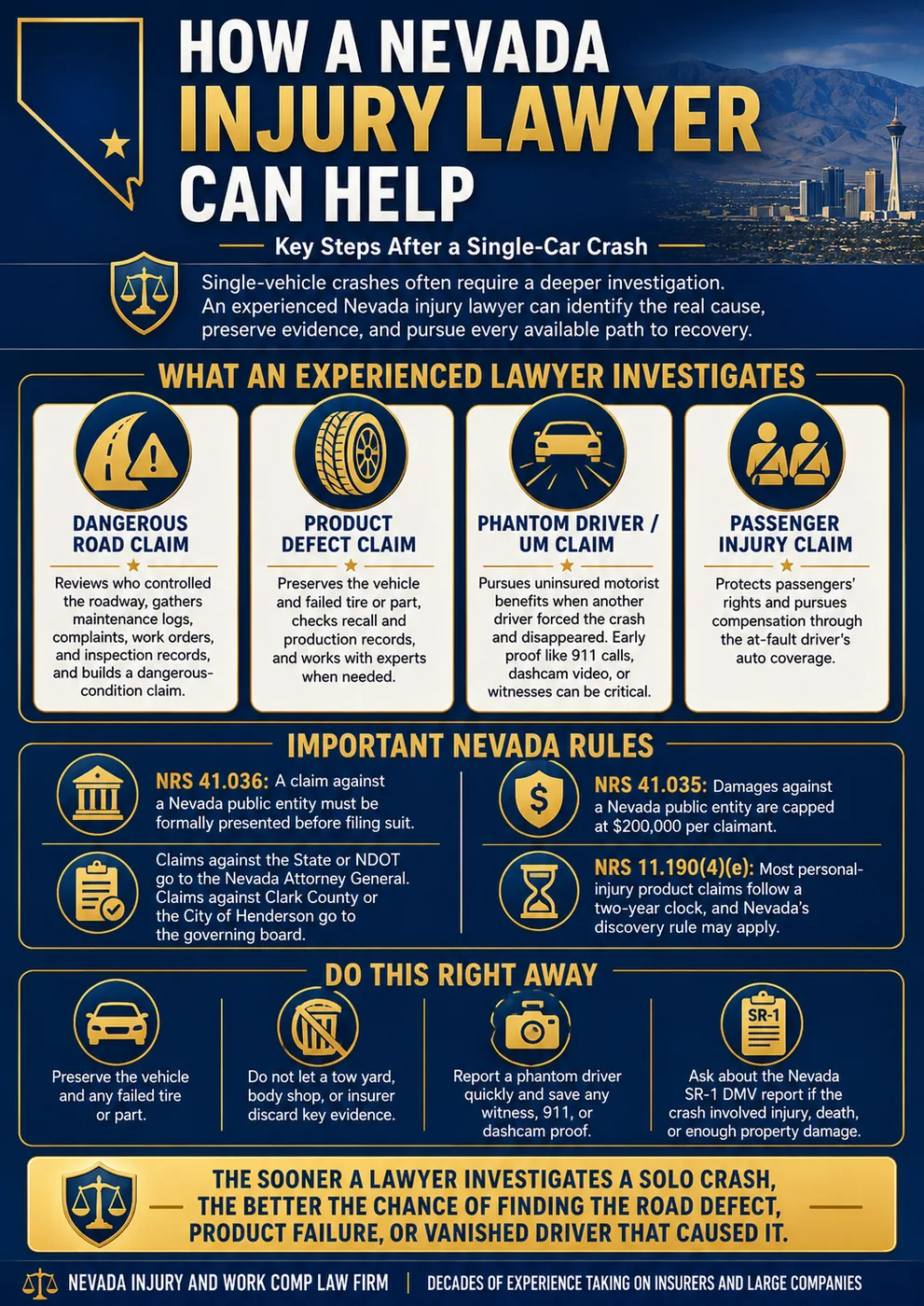
There's a step you can't skip. Under NRS 41.036, a claim against a Nevada public entity has to be formally presented to that body before you file suit. A claim against the State or one of its agencies, like NDOT, goes to the Attorney General. A claim against Clark County or the City of Henderson goes to that government's governing board. Nevada doesn't impose the short 30 or 60-day notice trap that some states do; the time to present is generally tied to the same two-year injury window. It's still a step that sinks otherwise strong claims when nobody handles it. One more thing worth knowing up front: under NRS 41.035, damages against a Nevada public entity are capped at 200,000 dollars per claimant. If you think a dangerous road put you off the pavement, talk to us about a dangerous-condition claim now, not later.
A Failed Tire or Part Points to a Product Claim
A lot of solo crashes start with a part that should never have failed. A tire that sheds its tread at highway speed. A brake that fades to nothing on a downhill. A steering or suspension piece that breaks and sends the car off the road. When that happens, the driver didn't lose control out of carelessness. The vehicle failed them.
These are product claims, and they live or die on the physical evidence. The first thing we do is preserve the failed part exactly as it is. Don't let a tow yard, a body shop, or an insurer throw out the tire or scrap the car before it's examined. We pull the production records, the recall history, and the service history, and when the facts call for it we bring in an engineer to inspect the failed component.
A tire failure that flips a vehicle has a lot in common with what we see on our rollover crash page, and the injuries can be just as serious. If a part failure caused your wreck, the maker or the seller can be held responsible, and that's a separate path to recovery from anything the road did. One thing that helps these cases: Nevada has no special statute of repose that shuts the door on a product claim just because the part was old. A defective-product injury claim runs on the same two-year personal-injury clock under NRS 11.190(4)(e), and Nevada's discovery rule means that clock generally starts when you knew, or reasonably should have known, that a defect caused your injury, not necessarily the day the tire left the factory. Keep the evidence and call before it disappears.
A Phantom Driver and Your Own UM Coverage
Plenty of single-vehicle crashes aren't really solo at all. Someone drifts into your lane, forces you onto the shoulder or into the median, and keeps driving like nothing happened. There's no contact, so on paper it reads as a one-car wreck. In practice, another driver caused it and then left.
Nevada treats this a lot like a hit-and-run. When the at-fault driver can't be found, your own uninsured motorist coverage is built to step in and pay for your injuries. There's a catch worth knowing: insurers often demand prompt reporting and some independent proof that the phantom vehicle existed, like a 911 call, a dashcam clip, or a witness who saw the swerve. The sooner you lock that down, the harder it is for the adjuster to wave it away.
This overlaps closely with our work on uninsured motorist coverage and hit-and-run claims. And here's the part people don't expect: in a UM claim, you're dealing with your own insurance company, and they don't always treat you like a customer. Having someone on your side keeps that pressure where it belongs.
"The people at the Law office of Erik Severino were always very helpful. They were always very prompt at answering my emails & phone calls. And they were always happy to answer any questions I had."
Passengers Almost Always Have a Claim
If you were the passenger when the car went off the road, your situation is clearer than you'd think. You weren't driving, so the wreck almost certainly wasn't your fault. The driver had a duty to get you there safely, and when their choices land you in the hospital, their auto insurance is there to cover it.
The hard part is usually emotional, not legal. The driver is often a friend, a partner, or a family member, and it feels wrong to make a claim against them. But the claim isn't really against the person. It's against the insurance policy they pay for, which exists for this exact moment. A fair recovery for your medical bills and lost time doesn't have to cost you the relationship, and a good lawyer handles it so it doesn't get personal. Our passenger injury page goes deeper on how this plays out.

Going Off the Road Hits the Body Hard
Hitting a median, a barrier, or a pole puts your body through a violent jolt, and a rollover multiplies it. These are the injuries that bring people to us after a solo wreck.
- ✓Concussion and TBI
- ✓Whiplash and neck strain
- ✓Herniated discs
- ✓Broken ribs and arms
- ✓Knee and ankle damage
- ✓Internal injuries
Five Moves That Keep a Solo-Crash Case Alive
You don't have to do all of this perfectly. Do what you can, and we'll handle the rest.
Get Checked Out
See a doctor the same day if you can. It protects your health and dates your injuries.
Save the Vehicle
Don't let the tire, the part, or the car get scrapped. The failed piece is your proof.
Photograph the Road
The pothole, the missing sign, the work zone, skid marks. Conditions get fixed fast.
Find Witnesses
Anyone who saw a swerve or a phantom driver. Get names and numbers before they leave.
Call Erik
We send preservation letters and notice to the right agency before the clock runs.
Under NRS 11.190(4)(e), you generally have two years from the crash to file a Nevada injury lawsuit. A claim against the Nevada Department of Transportation, Clark County, or a city adds a step: it has to be formally presented to that government body first, under NRS 41.036. Don't let a missed presentation step end a strong road-defect case. Talk to us early.
If Your Crash Looks a Little Different
Single-vehicle wrecks blur into a few other situations. Start with the one closest to what happened to you.
Single-Vehicle Crash Questions, Answered Plainly
Find Out Who Really Owes You
Tell us what happened. We'll tell you, honestly, whether a road agency, a parts maker, a phantom driver, or the person you were riding with can be held responsible. No pressure, no cost, no obligation.
Prefer to call right now?
(702) 360-5000Start Your Free Case Review
We respond within the hour.